
Blog · 17 min read
7 Best Intent Data Tools for Qualified Leads (Ranked)
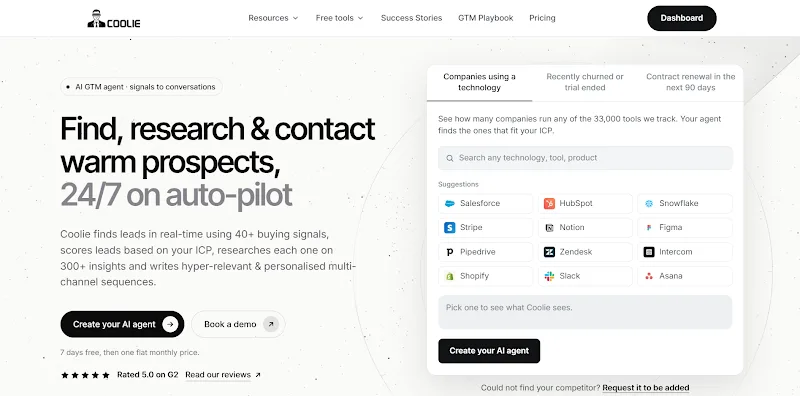
Your team has 1,000 companies on its target list, but which ones are worth contacting this week? One might be hiring for roles that mention technologies relevant to your product, another could be approaching a competitor’s contract renewal, and a third may have just churned from a competing tool. Those accounts present very different opportunities, yet a static lead list treats them much the same.
Intent data tools help identify these signals and track down leads who’ve shown interest in buying your services. The challenge is finding a tool that surfaces accurate signals, provides reliable contact data, and cuts down on the manual work involved in qualifying leads.
I tested top intent data tools personally. This article covers the 7 best worth considering.
How I Evaluated These Tools
I evaluated each platform based on how useful its intent data is for finding and qualifying potential customers. I focused on five things:
- Signal coverage: Does it track meaningful buying behaviors, such as competitor activity, technology changes, hiring, and topic research?
- Data quality and freshness: How reliable is the data, how frequently is it updated, and how much context does each signal provide?
- Targeting capabilities: Can you narrow down companies and contacts using filters relevant to your ICP?
- Actionability: Does the platform help you turn signals into prospect lists, enriched contacts, and outreach campaigns?
- Pricing and limitations: What do you get for the price? Are important features locked behind higher-tier plans, credit limits, or paid add-ons?
I also considered what makes each tool different, rather than ranking them purely by the number of features they offer. A platform with fewer signals can still be a strong choice if those signals are particularly relevant to your sales workflow.
Best Intent Data Tools: Comparison Table
| Tool | Main intent signals | Standout feature | Starting price |
|---|---|---|---|
| Coolie | Competitor activity, LinkedIn engagement, technology usage, hiring, renewals | 40+ signals, custom signals, and built-in outreach | $123/month |
| Apollo | Company research activity across hundreds of topics | Combines intent data with contact database and email sequences | $65/user/month |
| Lemlist | Hiring, LinkedIn engagement, technology changes, Bombora intent | Signal Agents connected to email, LinkedIn, and call campaigns | $69/user/month; Buying Intent add-on from $29/month |
| 6sense | Keyword research, website visits, email and campaign engagement | Predictive account scoring and ABM audience segmentation | Custom pricing |
| G2 Buyer Intent | Profile views, pricing views, competitor comparisons, alternatives and category visits | Specific software evaluation activity across G2 and partner review sites | Custom pricing |
| ZoomInfo | Topic research and increased company research activity | Person-Level Intent and Guided Intent | Custom pricing |
| Cognism | Topic research, hiring, job changes, funding, M&A and technology usage | Bombora-powered intent data alongside B2B contact intelligence | Custom pricing |
1. Coolie: Best overall
Coolie helps sales teams find leads already showing signs of potential buying intent, identify the right decision-makers, and turn those signals into personalized outreach.
This is possible because Coolie tracks indicators of shifting behavior signifying that leads may now be more receptive to your offer. Coolie covers 40+ of these buying signals, including:
- Competitor activity: Track competitor users, companies that recently churned or ended a trial, and upcoming renewals to identify potential switching opportunities.
- Technology and buying intent: Find companies using specific technologies or publishing job descriptions mentioning topics relevant to your product.
- LinkedIn engagement: Identify ICP-fit prospects engaging with your posts, competitor content, and industry discussions around relevant keywords.
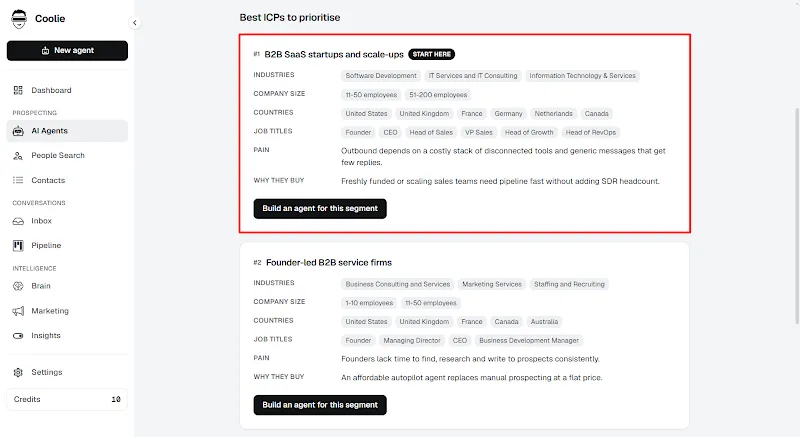
To get started, create an AI Agent, select high-intent signals as your data source, and enter your website URL. Coolie then identifies relevant ICPs that you can target. You can also always edit the particulars of an ICP segment (job titles, countries, company size, etc.) as needed.
Choose which group Coolie tracks signals for, or create separate agents to cover different segments of your ICP.
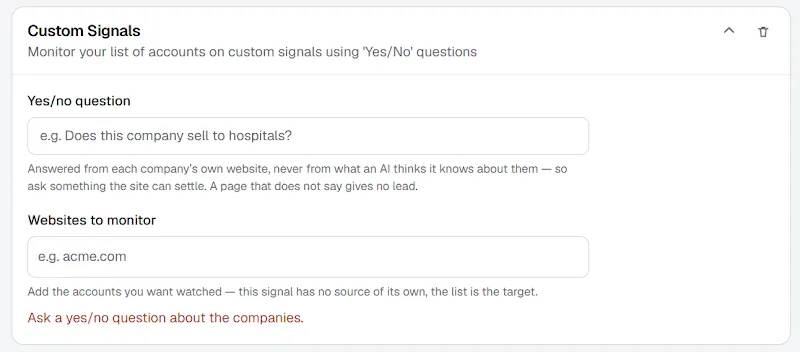
Next, select the signals you want to track and arrange them in order of priority. If none match your needs, Coolie lets you create custom signals to track specific events or conditions, so you can define a yes/no criteria to determine whether a company meets your requirements. For example, you could ask whether a company sells to hospitals, operates in a particular market, or offers a specific type of product.
I tested Coolie’s signals in my own outreach campaigns to see how well they could identify potential leads. I focused on two groups: people who had engaged with my LinkedIn posts, and people who had interacted with posts from others in my space. I then used Coolie to draft and send personalized messages directly through my LinkedIn account.
The results: a 57.4% connection acceptance rate and a 29% message reply rate. For context, my usual LinkedIn reply rate without Coolie sits somewhere between 10% and 25%.

Other Key Features
Beyond providing intent data, Coolie also includes a few other features worth mentioning:
- Contact enrichment: Find additional company and contact information through waterfall enrichment, drawing on 15+ data providers.
- Outbound campaigns: Build automated email and LinkedIn sequences with conditional steps, A/B testing, and personalized messages. You can approve messages individually or let campaigns run on autopilot.
- Pipeline CRM: Track outbound conversations in Coolie's built-in CRM and follow each contact through the different stages of your sales pipeline.
- Coolie's Brain: An AI system that learns from your outreach results. It analyzes replies to identify which signals, job roles, industries, channels, and message variations generate positive responses, then uses those insights to improve lead prioritization and future messaging.
- Marketing agent: Draft LinkedIn and X (Twitter) posts in your own voice, using what Coolie knows about your business and market.
Pros
- Identifies leads based on 40+ real-time buying signals
- Lets you create custom intent signals based on specific criteria relevant to your ICP
- Automates prospect research and contact enrichment
- Supports multichannel outreach (LinkedIn and email, with WhatsApp coming soon) from one platform
Cons
- Finding the right targeting criteria can take some trial and error
- Credit consumption can become a concern if you’re enriching contacts
Pricing
Coolie offers a Starter plan for $123/month and a Done-For-You plan for $994/month. It also has a Flat File option starting at $494 as a one-time payment. You can try the platform free for seven days before committing to a plan.
2. Apollo: Best for breadth of intent signals
Apollo is a sales intelligence platform with a buying intent feature that helps you identify companies researching topics relevant to your product or service.
To get started, head to the People or Companies tab and set up your ICP using filters such as job titles, company size, industry, location, and keywords. You can also save these filters as personas, so you don't have to configure your targeting criteria every time you run a new search.
Once you've narrowed down your audience, open the Buying Intent filter to find prospects researching topics related to your offering.
Here, you can filter companies based on their intent scores (high, medium, low) and the topics they're researching. Apollo has hundreds of intent topics, ranging from programming languages to financial software.
Once you've found a company/person, you can hover over their respective intent signal to get more details about their activity and how intent has moved over the past few months.
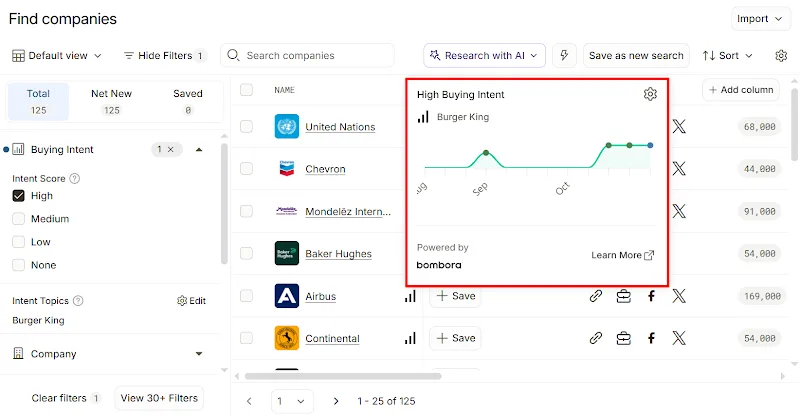
However, since Apollo is primarily a prospecting and enrichment platform, it doesn't offer the same breadth of intent signals as a more dedicated platform. For example, Apollo doesn't scrape LinkedIn to identify prospects engaging with your posts, so you won’t be able to replicate a similar workflow to what I described for Coolie.
You also won't find signals such as leads who have upcoming renewals or have recently churned from a competitor. Plus, the buying intent signals that are available are only scraped and updated weekly, which is quite a bit slower than what I would like.
Other Key Features
- Contact enrichment: Find business email addresses, phone numbers, and additional company information. Apollo also supports data enrichment through multiple providers.
- Email sequences: Build automated outbound campaigns with follow-ups and conditional steps based on prospect engagement.
- CRM integrations: Sync contact and account data with platforms such as Salesforce and HubSpot.
Pros
- Lets you filter companies by intent score and activity timeframe
- Provides additional context on when and how frequently companies engage with tracked topics
- Supports saved searches and email alerts for matching accounts
Cons
- Intent data is primarily based on company-level research activity
- Doesn't cover more specific behavioral signals, such as competitor engagement and LinkedIn interactions
Pricing
Apollo's paid plans start at $65/user/month (Basic), $99/user/month (Professional), and $149/user/month (Organization). Buying intent is limited to 1 topic on the Free plan, 6 on Basic and Professional, and 12 on Organization.
3. Lemlist: Best for multichannel, intent-based outreach
Lemlist is a sales engagement platform with a range of buying intent signals that help you identify potential leads based on their online activity and changes within their companies.
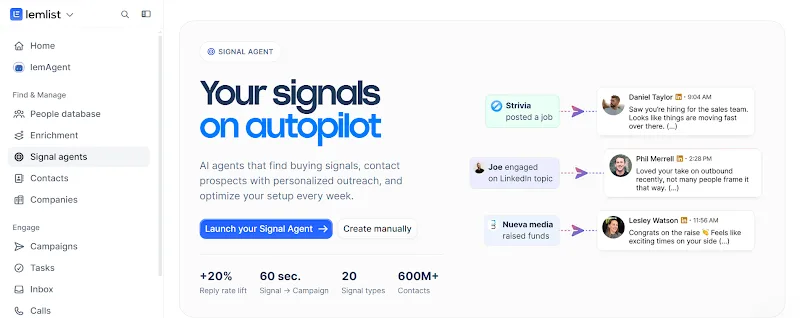
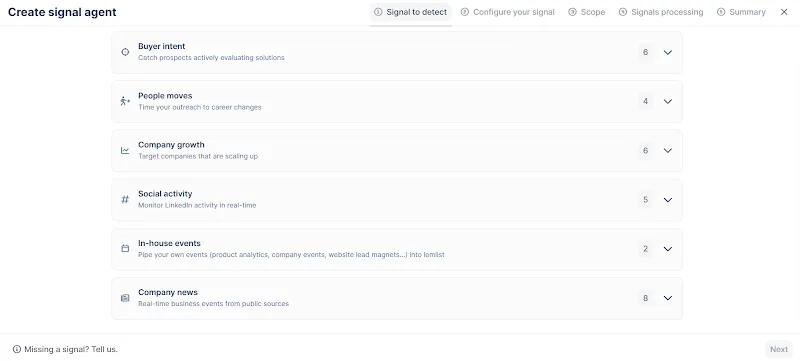
You can access these signals through Lemlist's Signal Agents. To get started, create a signal agent, select the type of activity you want to monitor, and define the companies or contacts you're interested in tracking. For example, you could set up an agent to
- identify companies hiring for specific roles,
- monitor LinkedIn engagement around relevant topics,
- identify companies that have recently switched CRM or sales tools.
Lemlist also offers a Buying Intent signal powered by Bombora (one of the biggest intent data providers). This lets you identify companies researching topics related to your product or service. You can select relevant topics and review companies showing increased research activity. Each result includes an intent level (Early Research, Active Research, or In-Depth Research), the topics being researched, and a composite score indicating the level of interest.
But relying on third-party data for this means you get the same limitation as Apollo: the data is refreshed weekly rather than in real time.
Lemlist covers a decent range of intent signals, but I found a few that would really make the difference missing: identifying companies that recently churned from a competitor or are approaching a competitor contract renewal.
Plus, Lemlist only detects when a company adopts, drops, or switches technologies, but with a tool like Coolie, you can also find companies that currently use a specific product.
Other Key Features
- Contact enrichment: Find business email addresses, phone numbers, and other contact details using multiple data providers.
- Multichannel campaigns: Build automated sequences combining email, LinkedIn, and calls.
- AI sequence builder: Generate personalized outreach sequences using your ICP, value proposition, and available lead information.
Pros
- Tracks a broad range of signals
- Connects detected signals to lead enrichment and outreach campaigns
- Includes AI-powered research and personalized messaging
Cons
- Bombora-powered Buying Intent is limited to weekly updates
- Doesn't offer signals for competitor customer churn or upcoming renewals
- Signals consume a considerable number of credits, so the cost piles up
Pricing
Lemlist's Email plan starts at $69/user/month, while its Multichannel plan starts at $109/user/month. Buying Intent Signals is a separate add-on, starting at $29/month for 100 signals. You can also purchase it without an Engagement plan.
Note that signal usage consumes credits, so the subscription price isn't necessarily your total cost. Most signals, including hiring, job changes, and technology changes, cost 100 credits per successful result.
At $0.01 per credit, that's $1 per standard signal. So identifying 100 companies that recently changed their tech stack or started hiring would cost around $100 in signal credits, on top of your subscription and data add-on fees.
4. 6sense: Best for enterprise use
6sense is an account-based marketing and sales intelligence platform that combines intent data, company information, and engagement signals. So it isn’t just an intent data provider, but a whole suite.
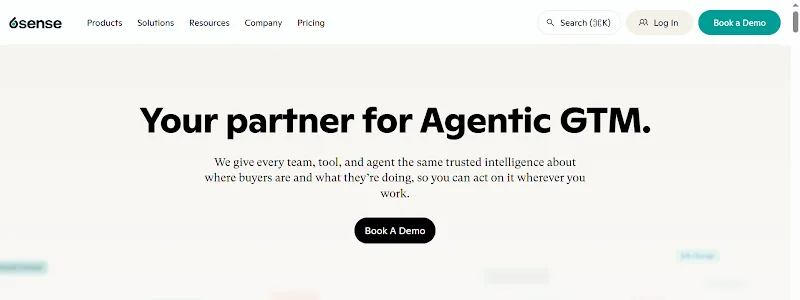
A short disclaimer: 6sense is geared towards large enterprise uses (and its pricing reflects this), so if you’re solo or part of a lean team, I wouldn’t consider it the ideal fit.
So why include it in the list? It's one of the more advanced data providers out there.
Among the main features is its intent data network, which tracks what companies are researching across the web. You can monitor branded keywords to understand interest in your product and competitors, or use generic keywords to identify companies researching topics relevant to your offering.
6sense also groups related keywords together and uses AI to recommend additional keywords based on the activity of your target accounts.
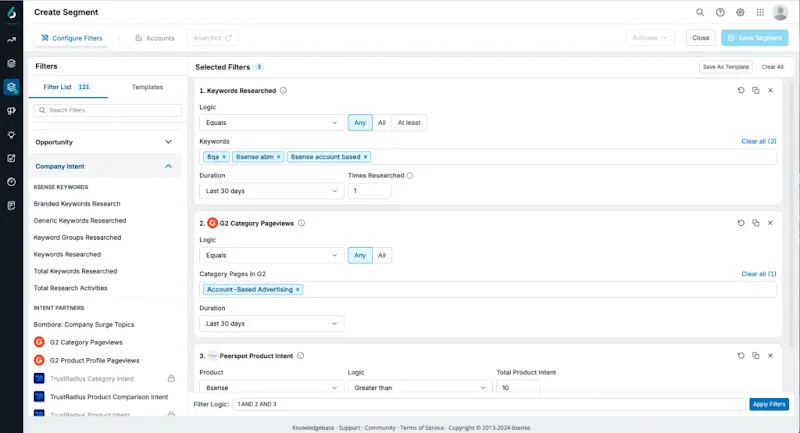
You can use these signals to build audience segments. For example, you can filter accounts based on how many times they've researched specific keywords, how many keywords they've researched within a group, and the timeframe of that activity.
6sense combines third-party intent data with first-party activity: website visits, email engagement, and campaign interactions, alongside company information like industry, revenue, technology usage, and hiring activity.
Its predictive models use these signals to classify accounts into buying stages (Target, Awareness, Consideration, and Decision).
Other Key Features
- Predictive account scoring: Evaluates account fit, intent, buying stage, engagement, and buying group reach.
- Campaign activation: Push audience segments to advertising platforms, LinkedIn, CRM systems, and sales engagement tools such as Outreach and Salesloft.
- AI account research: RevvyAI lets users ask questions about an account, including which buying group members are involved, what signals are driving its classification, and what action to take next.
Pros
- Tracks both keyword-level research and first-party website activity
- Uses predictive scoring to assess buying stages and prioritize accounts
- Supports dynamic audience segments and configurable activity alerts
Cons
- Primarily focused on account-level intent and prioritization, rather than individual behavioral signals such as LinkedIn post engagement
- Requires some configuration to set up keyword groups, filters, and audience segments
- The platform's breadth of features is overkill for smaller sales teams
Pricing
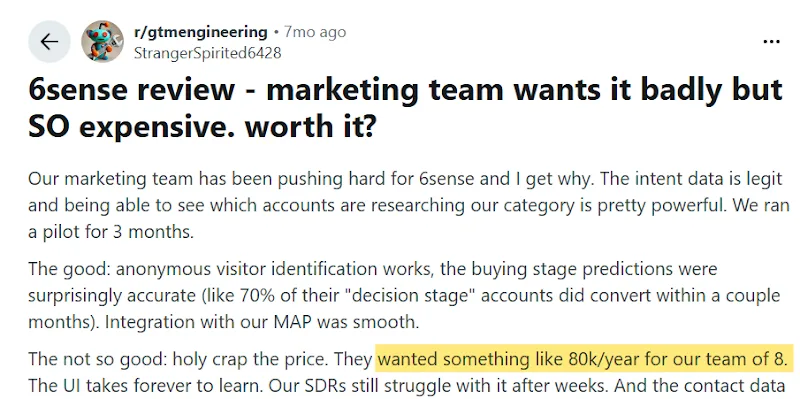
6sense doesn't publish standard pricing on its website. You'll need to contact its sales team for a quote. But individual accounts report between $50k–$100k/year.
Here is a Reddit thread I came across, for instance, where the poster claims to have been quoted $80k for their team of eight.
5. G2 Buyer Intent: Best for identifying companies actively comparing software vendors
G2 Buyer Intent is quite different from the other tools on this list. Unlike Coolie, Apollo, and Lemlist, which track broader research activity across the web, G2 focuses on software specifically. And since they’re the biggest review platform, their data for this use case is among the best.
G2 tracks several types of buying signals:
- Profile views: Someone at a company viewed your product profile on G2.
- Pricing views: Someone visited your G2 pricing page, suggesting they're evaluating your product against their budget.
- Compare: Someone viewed a comparison page featuring your product and a competitor.
- Alternatives: Someone viewed an alternatives page for your product or a competitor in your category.
- Category: Someone visited a G2 category page that includes your product.
- Competitive: Someone viewed the profile, pricing, or comparison page of a competing product.
You can filter these signals by company size, industry, location, market segment, product, competitor, and activity type. You can also set a date range to focus on recent research activity.
G2 also assigns each company two scores to help you prioritize leads. Buying Stage classifies companies as Awareness, Consideration, or Decision based on their activity and the types of pages they visit. Activity Level rates their research activity as Low, Medium, or High, using factors such as pageviews and time spent on pages.
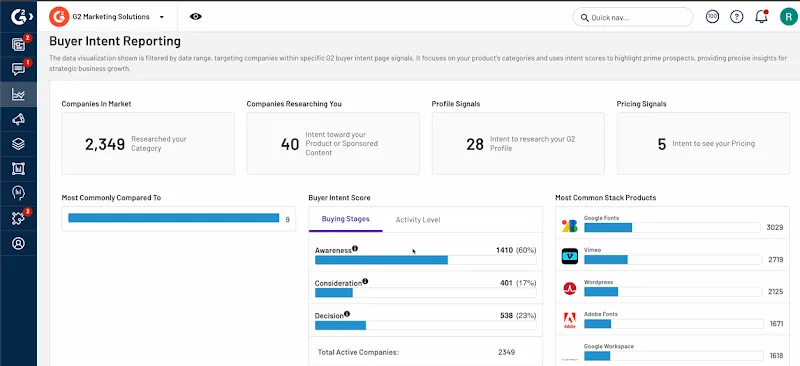
For example, you could prioritize a company that has viewed your pricing page, compared your product with a competitor, and reached the Decision stage. That's a much stronger indication of software evaluation than a company that has only visited a category page.
Other Key Features
- Email notifications: Set up recurring alerts for companies matching your ICP and signal criteria.
- Intent Studio: Automatically send signals from companies matching your ICP to selected integrations.
- G2 Audiences: Build advertising audiences from companies researching your category, viewing your product, or looking at competitors. You can sync these audiences with platforms such as LinkedIn Ads and Reddit Ads.
Pros
- Tracks specific software evaluation activity, including pricing views and competitor comparisons.
- Includes research activity from G2, Capterra, Software Advice, and GetApp
- Provides detailed company activity histories and recurring alerts
Cons
- Primarily provides company-level insights rather than identifying individual visitors by name
- Focuses on software research across review platforms, so it won't capture every buying signal happening elsewhere
- Requires a separate subscription for each G2-listed product you want to track
- Available signal types depend on your G2 plan
Pricing
G2 doesn't publish standard pricing for Buyer Intent. The signals available depend on your G2 subscription, and each product you want to track needs its own subscription. You'll need to contact G2 for a quote and to confirm which signals are included in your plan.
6. ZoomInfo: Best for finding decision-makers behind buying intent
ZoomInfo is a sales intelligence platform with a buying intent feature that helps you identify companies and individual contacts researching topics related to your product or service.
To get started, select the intent topics you want to monitor. ZoomInfo organizes these into predefined topic clusters, which group related keywords together. For example, if you sell sales engagement software, you could monitor topics around sales automation, cold email, and sales intelligence.
You can also create Custom Intent topics using your own keywords, which is useful if you're selling a more specialized product or targeting a niche market.
Once you've selected your topics, you can search for companies showing increased research activity. ZoomInfo assigns intent scores based on how much research activity has increased compared to a company's historical baseline. You can also set an intent strength threshold and lookback period to narrow down your results.
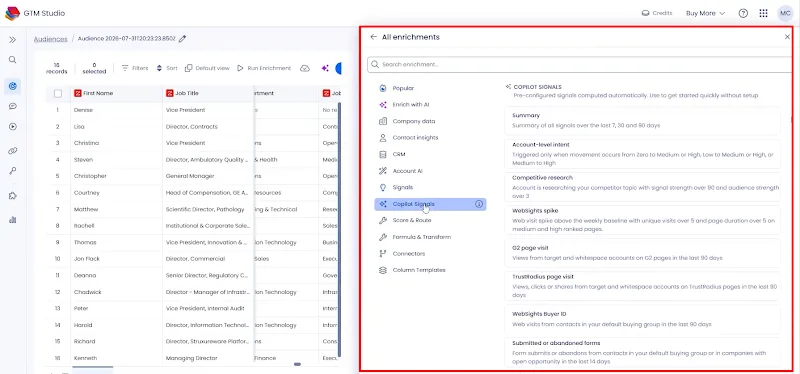
Two features help make this data more actionable:
- Person-Level Intent: Identifies named contacts associated with research activity when that information is available. You can narrow the results using filters such as job title, seniority, company size, and revenue.
- Guided Intent: Recommends topics based on research patterns historically associated with closed-won deals.
One limitation is that Person-Level Intent doesn't necessarily identify the individual responsible for every research activity. ZoomInfo only surfaces named contacts when it can associate them with the underlying signal. Also, while its intent data comes from multiple sources, the available refresh frequency depends on your package and configuration.
Other Key Features
- Contact and company enrichment: Access business email addresses, direct phone numbers, job titles, firmographic details, and other information from ZoomInfo's B2B database.
- Scoops: Track company initiatives and planned investments reported by knowledge workers, giving you additional context around potential purchasing decisions.
- Sales workflows: Automate actions based on intent and other signals, including CRM updates, sales tasks, notifications, and audience exports.
Pros
- Combines buying intent with a large B2B contact and company database.
- Supports both account-level and person-level intent.
- Lets you create custom topics and use Guided Intent to identify relevant research patterns
Cons
- Person-Level Intent only identifies named contacts when they can be associated with the underlying research activity.
- Requires some work to configure relevant topics, clusters, and filters.
- Advanced capabilities and data freshness options depend on your package.
7. Cognism: Best for combining Bombora intent signals with prospecting
Cognism combines third-party intent data with a B2B contact database. This lets you identify companies researching topics relevant to your product and find the decision-makers to contact from the same platform.
Like Apollo and certain signals from Lemlist, Cognism takes its data from Bombora. You can choose from more than 11,000 intent topics, with up to 12 available at a time.
Cognism's Intent tab shows companies researching your selected topics. You can filter accounts by Surge Score and changes in activity over the past seven days, including companies showing intent for the first time or increasing their research.
Cognism also provides other company signals, including hiring trends, job changes, funding announcements, and M&A activity. Its technographic data lets you identify companies using specific technologies.
However, Cognism's intent offering does have a few limitations. For starters, you're limited to 12 Bombora topics at a time.
The bigger limitation is signal coverage. Other tools I’ve covered (like Coolie) can identify prospects engaging with LinkedIn posts, companies approaching a competitor's contract renewal, and recent competitor churn. This isn’t possible with Cognism.
Other Key Features
- Contact enrichment: Access business emails, phone numbers, job titles, and company information, including phone-verified mobile numbers through Diamond Data.
- CRM enrichment: Keep company and contact records updated in your CRM.
- Prospecting: Build targeted account and contact lists using Cognism's company and people filters.
Pros
- Combines Bombora-powered intent data with a B2B contact database
- Offers more than 11,000 intent topics
- Lets you filter accounts by intent strength and changes in research activity
- Includes additional company signals and technographic data
Cons
- Limited to 12 selected intent topics at a time
- Doesn't offer more specific behavioral signals, such as competitor LinkedIn engagement or upcoming contract renewals
Pricing
Cognism doesn't publish fixed prices. It offers Standard and Pro packages, with intent data included in Pro alongside more advanced prospecting features.
Conclusion
My advice: Don't choose an intent data tool based on how many signals it claims to track. Focus on whether those signals help you identify the right accounts, reach the right people, and take action at the right time.
Try the platform first, if a free trial is available, and see how well it fits your sales workflow before committing to a paid plan.
- If you want a range of buying signals and an all-in-one prospecting and outreach workflow, start with Coolie. It tracks 40+ signals, including LinkedIn engagement, competitor activity, technology usage, and upcoming renewals. You can also use those signals to find prospects, enrich their contact details, and launch personalized outreach campaigns from one platform.
- If you need a large B2B contact database alongside basic buying intent, try Apollo. It combines prospecting, contact enrichment, and intent topics in one platform, making it a practical option if you don't need highly specialized behavioral signals.
- If you want to connect buying signals directly to multichannel outreach, go with Lemlist. Its Signal Agents help identify potential leads based on activities such as hiring, LinkedIn engagement, and technology changes, while its campaign builder lets you reach them through email, LinkedIn, and calls.