GTM Playbook · 15 min read
Why Event Signals Create Better Outbound Opportunities?
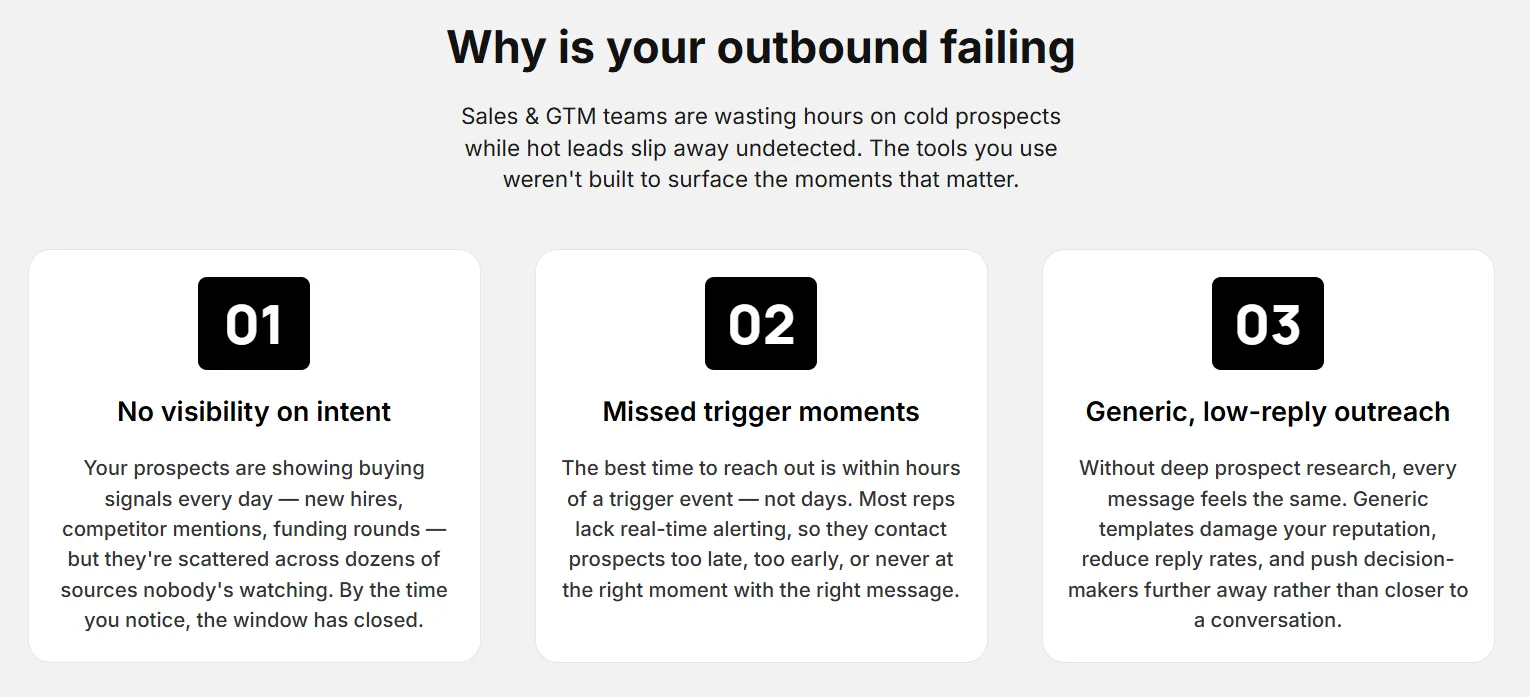
The best outbound does not begin with a static list of companies that match an ICP. It begins when something changes.
A company can be the perfect size, in the right industry, and employ the right buyer — yet have no reason to care today. Event signals solve that problem. They reveal a change in priorities, budget, urgency, visibility, or capacity that creates a credible reason to reach out now.
The key is not to treat every signal as “purchase intent.” A signal is evidence of a possible business moment. Your job is to connect that moment to a specific problem your product or service solves.
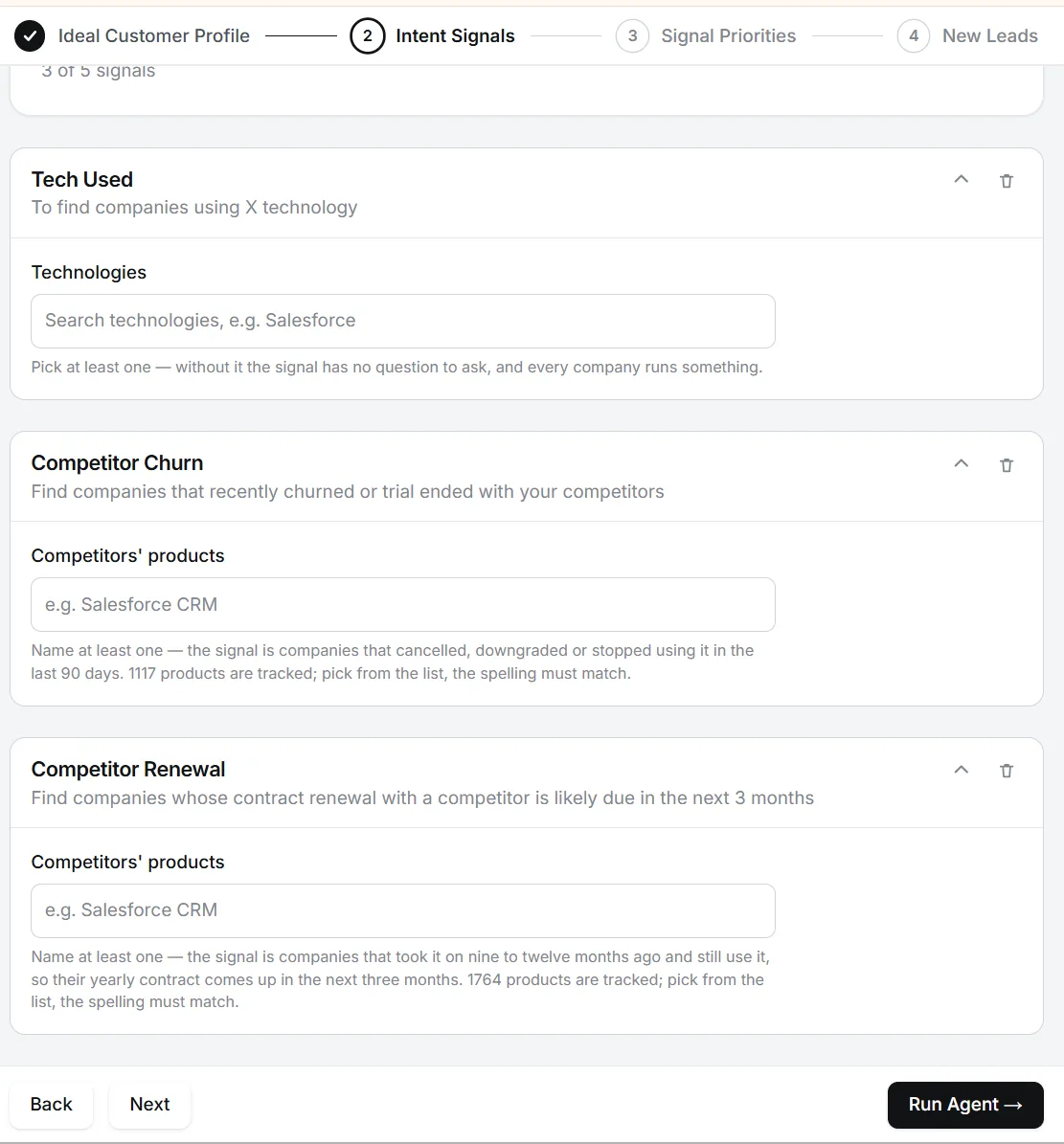
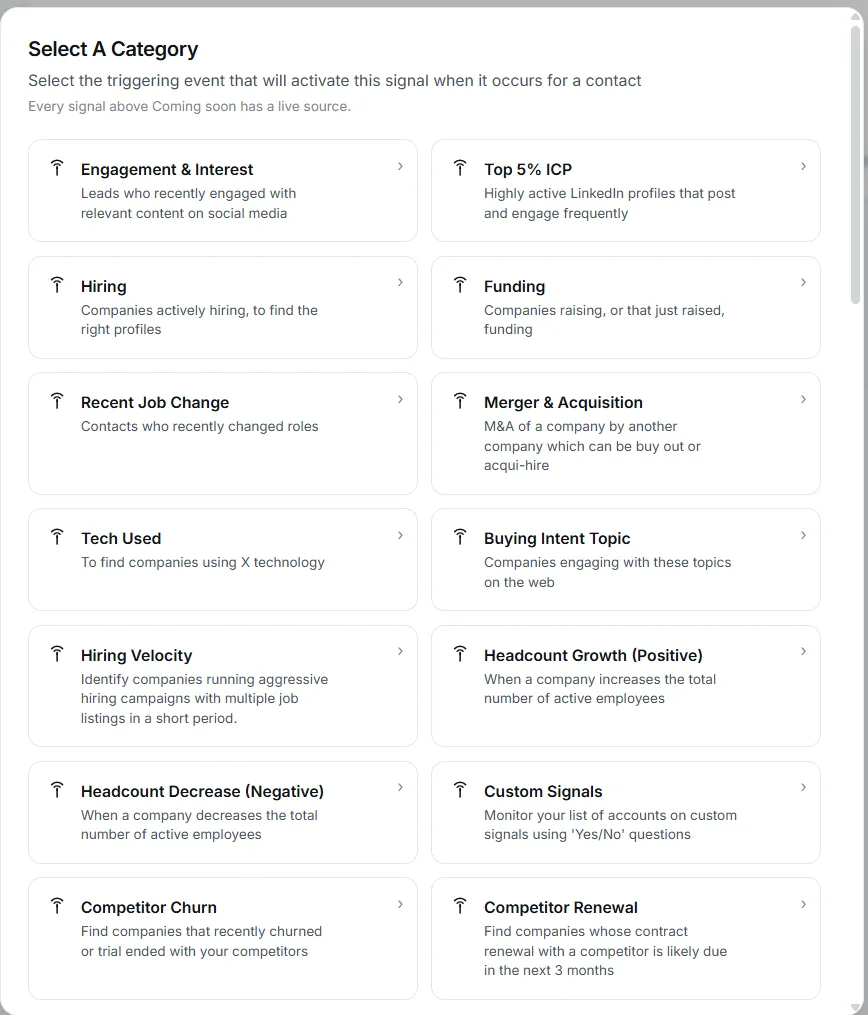
Competitor Churn or Trial Ended
Competitor churn or trial ended indicates a possible replacement window.
A company that has ended a contract, failed a trial, publicly complained, or moved away from a competitor may be actively looking for an alternative. The buyer already understands the category and has experienced a failed solution, so the conversation can move quickly if your offer directly addresses the reason for churn.
The outreach angle: Position a safe alternative and de-risk switching. “Teams moving away from X often want to avoid Y. We provide a faster migration path and solve that issue through…”
Competitor Renewal
A renewal creates a review point.
Companies often reassess pricing, adoption, ROI, service quality, and alternatives before a major contract renewal. Even if they ultimately renew, they may be open to a benchmark or backup option. This is particularly valuable for expensive, annual, or multi-year software and services contracts.
The timing matters. Contacting them 90 days before a major renewal is usually more useful than waiting until the final weeks.
The outreach angle: Offer evaluation support rather than a hard replacement pitch. “As teams review their current approach to X, we help them benchmark cost, performance, and implementation effort.”
Technology Used
Technology data tells you what a company has already chosen to build around.
If you sell an integration, implementation, migration, managed service, consulting engagement, or complementary product, this can be extremely useful. Knowing a company uses Salesforce, HubSpot, ServiceNow, Snowflake, AWS, Shopify, or a competitor can make outreach specific and credible.
The outreach angle: Focus on the likely challenge associated with that technology. “Teams scaling on X often hit Y once they reach Z. Is that relevant on your side?”
Buying-Intent Topics
When a company published, researches or engages with a topic on the web, it may be exploring a problem or evaluating solutions.
This can be useful for identifying accounts in an active research phase, especially for categories with long buying cycles: cybersecurity, data infrastructure, compliance, ERP, HR systems, and enterprise software.
The outreach angle: Make the message useful to someone researching. Offer a benchmark, checklist, case example, or point of view related to the topic.
Recent Job Changes
A new role usually means:
- New priorities
- Pressure to perform
- Desire to prove themselves quickly
- Openness to trying new tools and processes
New leaders are often expected to make an impact in their first 90 days. They assess what is broken, decide which initiatives deserve attention, and look for quick wins that establish credibility.
A new VP of Sales may review pipeline quality, outbound productivity, CRM hygiene, and SDR performance. A new CTO may assess engineering velocity, technical debt, cloud costs, security posture, and external development capacity. A new Head of Marketing may revisit attribution, demand generation, content, and tooling.
The outreach angle: Do not congratulate them and immediately pitch. Tie their new mandate to a likely priority: “New leaders in this role are often asked to improve X quickly. We help teams do Y without needing to rebuild their process.”
Funding
Funding means the company has more resources, but more importantly, it has a new expectation to grow.
Investors do not fund a business so it can continue operating at the same speed. The company now has targets around revenue, market expansion, product delivery, hiring, customer acquisition, or geographic growth. That creates urgency and often exposes gaps in people, processes, and systems.
For services businesses, funding can mean a company needs to ship faster than its internal team can manage. For sales technology, it can mean pressure to build pipeline and create repeatable go-to-market motion. For recruiting, it can mean a sudden need to hire before competitors do.
The outreach angle: Focus on what the capital is likely meant to unlock, not on the funding announcement itself. “Now that you are expanding the team/product into X, the bottleneck is often Y.”
Hiring
Hiring is a public declaration of priority.
A job description tells you what a company is trying to achieve, the skills it lacks, the systems it is adopting, and often the problem it is struggling to solve. A company hiring DevOps engineers may be improving deployment reliability or scaling infrastructure. A company hiring RevOps may be fixing an inefficient sales process. A company hiring a security leader may be responding to compliance pressure.
Hiring also reveals a capacity gap. The company has work that needs doing now, but lacks enough internal expertise or bandwidth to do it.
The outreach angle: Sell the outcome behind the role, not the fact that they are hiring. “You are clearly investing in cloud delivery. We help teams cover the implementation backlog while they build the internal function.”
LinkedIn Profile Engagement
When someone likes, comments on, or repeatedly engages with a founder’s posts, they are already familiar with the person, idea, or category.
This is not always buying intent. A like can be casual. But engagement reduces the biggest problem in cold outreach: total lack of context. The prospect has seen the founder’s thinking and may already recognize the company name.
Comments are particularly useful because they reveal language, opinions, objections, and active interests. A person commenting on a post about outbound quality, SOC 2, hiring, or AI adoption has given you a relevant conversation starter.
The outreach angle: Continue the existing conversation. “Your comment on X stood out — especially the point about Y. We have seen a similar issue with…”
Company or Team LinkedIn Engagement
Engagement with a company page or a teammate’s content indicates awareness of the brand or topic, even if the prospect has not interacted directly with the founder.
This works especially well for businesses where subject-matter experts publish useful content. A security consultant’s posts may attract security leaders. A product leader’s posts may attract product teams. An SDR leader’s posts may attract sales managers.
The signal becomes stronger when the same prospect interacts more than once or engages with multiple people from the company. That suggests they are following the problem space, not merely reacting to one post.
The outreach angle: Use the shared topic as the bridge. “You recently engaged with our team’s post on X. Curious — is this something your team is actively working on?”
Topic Engagement and Interest
People engaging with relevant LinkedIn content are showing that a problem, trend, or project is on their radar.
For example, a VP Engineering engaging with posts about cloud migration may be researching an upcoming initiative. A RevOps leader engaging with content about lead quality may be under pressure to improve pipeline efficiency. A CIO discussing workflow automation may be considering modernization.
However, topic engagement is usually an early-stage signal, not a purchase signal. It tells you what to talk about, not necessarily that the prospect is ready to buy.
The outreach angle: Lead with insight, not a demo request. “You have been following the discussion around X. One pattern we keep seeing is Y — is that relevant to your team this quarter?”
Company Followers
Following a company page indicates baseline category or brand awareness.
On its own, this is a weak signal. People follow companies for hiring news, industry updates, inspiration, competitor research, or general interest. But it becomes useful when combined with ICP fit, recency, engagement, or a relevant job change.
For example, a target account’s newly hired VP Sales who follows your company and engages with a post is far more interesting than a random follower.
The outreach angle: Use followers for nurturing and prioritization, not aggressive sales outreach. Make sure they see relevant proof, customer stories, and problem-focused content before asking for a meeting.
Competitor Profile Engagement
Someone following or engaging with a competitor understands the category.
That matters because category education is expensive. If the prospect already follows a competitor, they may already know the problem exists, recognize possible solutions, and be evaluating alternatives. They may be a customer, a former customer, a partner, a job seeker, or simply an interested observer — so do not assume dissatisfaction.
The best use of this signal is to identify people who may be receptive to a differentiated point of view.
The outreach angle: Never say, “I saw you follow our competitor.” Instead, speak to a category pain and your distinct approach: “Many teams using traditional X approaches struggle with Y. We take a different route by…”
Top 5% Active ICP Users
Highly active LinkedIn users are more visible, easier to research, and more likely to respond on the channel.
They regularly post, comment, react, and build a public perspective on their work. This gives you richer personalization material than an inactive profile with no recent activity. It also means they are more likely to notice and accept a relevant connection request.
But activity is not intent. A highly active CEO may be more reachable than another CEO, but not necessarily more likely to buy.
The outreach angle: Treat this as a reachability and personalization layer. Use it to prioritize accounts that already match another meaningful trigger.
Influencer Audience Engagement
Influencers, practitioners, analysts, and niche operators aggregate people interested in a shared problem.
If an ICP buyer engages with a respected sales leader’s content about pipeline quality, a security expert’s content about ransomware, or a CTO creator’s content about engineering velocity, they have self-identified around a relevant theme.
The quality of this signal depends on the influencer. A broad business influencer may generate a large but vague audience. A niche operator with a concentrated ICP can generate highly relevant prospects.
The outreach angle: Reference the problem or conversation, not the act of following the influencer. “The conversation around X has become much more practical lately — particularly around Y. Is that on your roadmap?”
Mergers and Acquisitions
M&A creates forced change.
Two companies now need to integrate teams, systems, data, processes, vendors, reporting structures, and customer experiences. Duplicate tools need to be consolidated. Security and compliance must be reassessed. Product roadmaps may change. Teams may need external capacity to execute integration work quickly.
This is a powerful signal because the event creates work whether the company wants it or not.
The outreach angle: Connect your offer to the operational consequence of the transaction. “After an acquisition, teams often face pressure to unify systems without slowing delivery. We help with…”
The Core Principle
Every signal answers one of four questions:
- Why now? Funding, hiring, M&A, vulnerabilities, renewals
- Why this company? Technology used, competitor activity, buying-intent topics
- Why this person? Recent job change, LinkedIn engagement, active ICP profile
- Why should they trust you? Shared conversations, relevant content, contextual insight
The best signal-based outbound is not “we saw an event, so we sent an email.”
It is: “Something changed. We understand what that change likely creates. We can help with the resulting problem. And we have a relevant reason to start the conversation now.”
How to Capture These Signals (Two Options)
Option 1: Manually. Doable. Set up LinkedIn Sales Navigator filters, follow competitor pages, monitor news. Expect ~3 hours per day per rep to do this well.
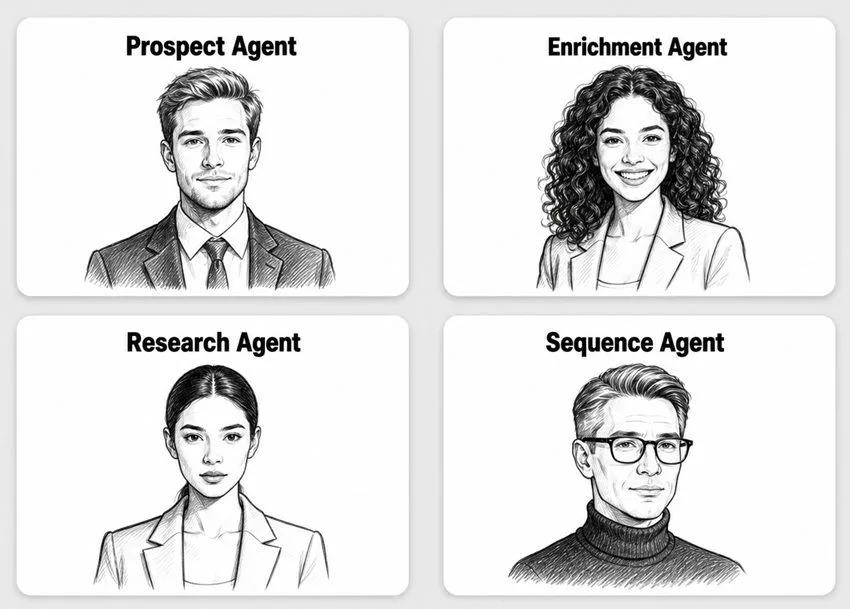
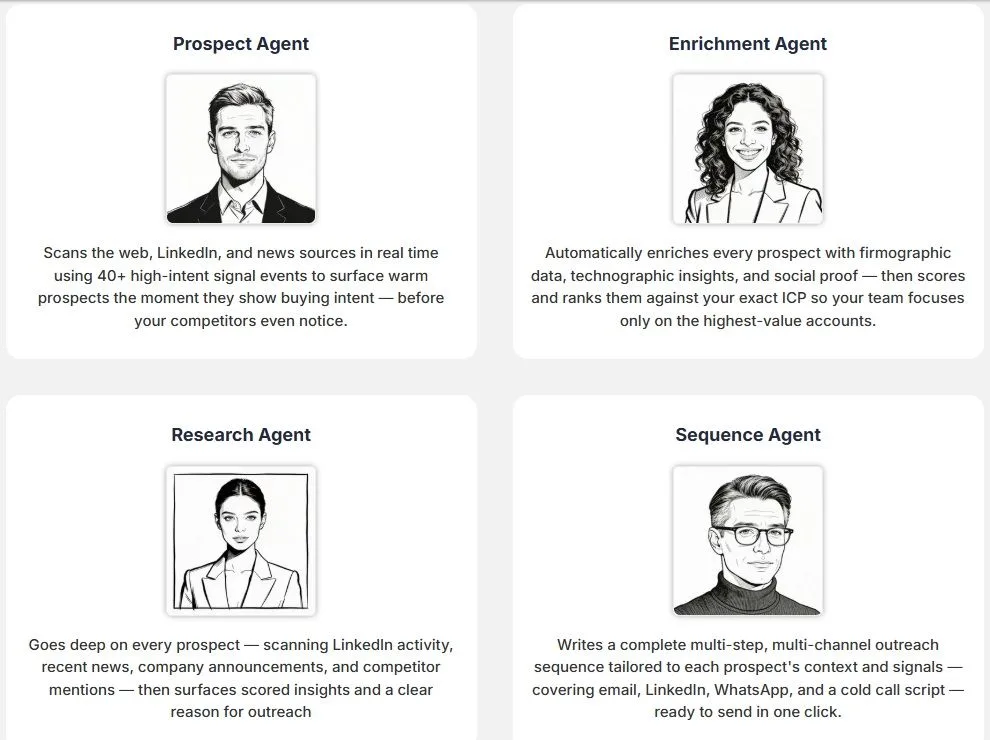
Option 2: Let agents do it. This is what Coolie's Prospect Agent is built for — it monitors LinkedIn, news, job boards and financial filings 24/7 across 40+ signal events and surfaces matched prospects every morning.
We track signals as fresh as less than 1 minute ago when they surface on the web.
Whichever route you take, the rest of this playbook applies the same way.
PART 2 - Research: Stop Personalising. Start Referencing Tension.
You've got high-intent leads. Now the harder question: What do you actually say?
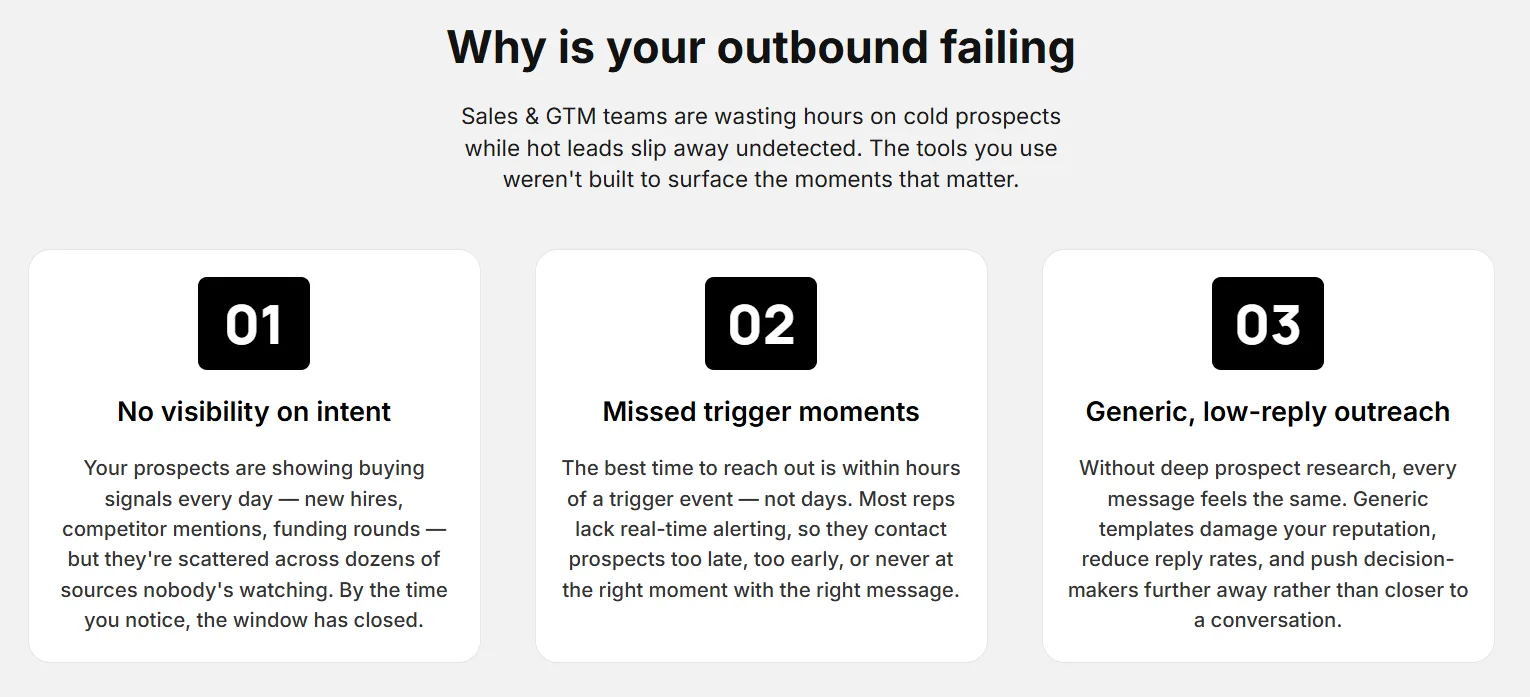
Most reps stop at "Congrats on the funding!" That's why most reps live at ~1% replies.
The funding round isn't the message. The pressure that funding round creates for your specific buyer — that's the message.
I call this 3rd-Level Research. Here's the full framework, then a real example.
The 3 Levels of Insight
Level 1 — The Observable Event
What happened.
Something public. A funding round. A leadership hire. A product launch. A new market push. Every seller sees it. Every seller sends the same congratulatory line. Nobody responds, because there's no thinking in the message.
Level 2 — The Strategic Intent
What they're doing with it.
Where is the money going? What does the hire signal about direction? You now have context. You've shown you can read a press release. But your prospect already knows all this — you haven't earned a reply yet.
Level 3 — The Tension It Creates
What's keeping them up at night right now.
The strategic move creates predictable internal friction for this role at this company. This is the conversation they're already having internally — with their boss, their team, themselves. Walk straight into that conversation and you're no longer pitching. You're contributing.
A Real Example: Hireflow Raises $12M
Level 1 — What everyone sees:
Hireflow raised $12M and is moving from SMB into Fortune 1000 enterprise.
Most reps send: "Congrats on the round! Would love to chat." → ignored.
Level 2 — Where the money is going:
Enterprise sales build-out, Fortune 1000 targeting, global HR buyers.
"Saw you're going upmarket — let's chat." → still ignored. They already know this.
Level 3 — The actual tension this creates for their VP of Sales:
- The SDR team was built for 30-day SMB cycles — enterprise runs 3–6 months
- HR, IT, Legal and Procurement are now in every deal — a motion they've never run
- Enterprise buyers are already embedded in Workday or SuccessFactors — switching cost is high
- Status quo bias is the real competitor, not another vendor
- The messaging that closed SMB will actively damage upmarket conversion
- The VP inherited a team and a playbook that weren't built for where the company is going
The message that actually books a meeting:
"Hi John, read the Forbes article on your enterprise push. As you move into Fortune 1000, are you seeing more resistance from buyers already locked into Workday or SuccessFactors than from competing point solutions? It's becoming the harder unlock for the teams we work with."
You're not referencing the funding. You're referencing the friction. That's the difference between a pitch and a peer-level conversation.
Doing 3rd-Level Research at Scale
Done manually, 3rd-level research is brutal — 15 to 20 minutes per prospect to pull insights, score them, and find the one that matters most for their persona. At 30 prospects a day that's an entire SDR's workday gone before they've sent a single message.
This is the gap Coolie's Research Agent is built to close. For every prospect it pulls 300+ contextual data points (product launches, hires, integrations, strategic moves, press) and scores each one against your value prop. You see the top 3–7 ranked, each with a "why this matters right now" explanation for the specific persona.
You get the 3rd-level insight in seconds instead of 20 minutes. The framework is the same either way — Coolie just makes it fast enough to run at GTM volume.
→ Want to try this on your own ICP? Start a free Coolie account — the first 3 prospects you add show you the full insight stack before you commit to anything.
PART 3 — Sequence: One Insight, Four Channels, Seven Days
Here's where most teams still lose. They find a signal. They write one decent personalised email. And when it doesn't reply, they default back to a generic template for the follow-ups — undoing the work that earned the first reply in the first place.
One insight is enough for an entire 7-day, 4-channel sequence — if you sequence it right.
The Multi-Channel Logic
Your VP of Sales prospect is not sitting in their inbox waiting for you. They're on LinkedIn at 8am, in meetings 10–12, on email mid-afternoon, on WhatsApp with vendors around 2pm, and answering their phone between 4 and 6.
A sequence built around a single 3rd-level insight — touched across the channels they actually use — compounds awareness without feeling spammy, because every touchpoint says the same thing in the same voice. You're not running four campaigns. You're having one conversation across four surfaces.
The 7-Day Cadence That Works
A simple, repeatable shape we've tested across thousands of prospects:
- Day 1, AM — LinkedIn connection request, no message. Just the request.
- Day 1, PM — Email #1: the insight + the question. Short. ~60 words. No pitch.
- Day 2 — LinkedIn message (if they accepted): conversational, references the same tension.
- Day 4 — Email #2: a new angle on the same tension. Not a "bumping this" follow-up.
- Day 5 — WhatsApp (if number verified): one line, very casual. "Hey — sent you a note on the Fortune 1000 buyer angle. Curious if it's on your radar."
- Day 7 — Cold call. Opener references the prior touches and the same insight. Objection handlers tied to the same tension.
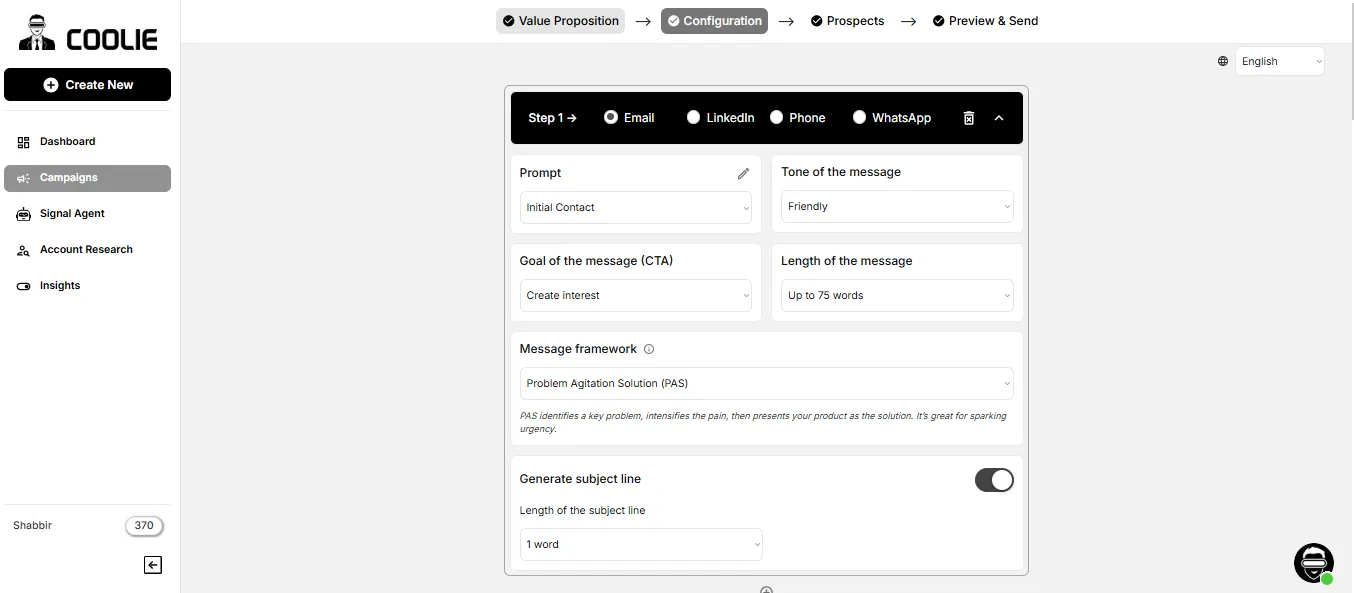
The key isn't the channels. It's the anchor. Every message references the same 3rd-level tension. Different angle, same conversation. That's what makes it feel like a peer reaching out four times — not four campaigns hitting one inbox.
What This Looks Like at GTM Scale
Hand-writing this sequence for one prospect takes ~30 minutes. For 30 prospects a day, it's not happening.
This is what Coolie's Sequence Agent automates: it takes the top-ranked insight from the Research Agent, your value prop, and the prospect's full context, and writes the entire 7-day multi-channel sequence — email, LinkedIn, WhatsApp and a cold-call script — all anchored to the same tension. You edit and send.
Same framework, 50–100 personalised sequences per day instead of 10.
Your First 4 Weeks
A realistic ramp. No "9 calls in 2 days" promises — that comes later, after the system has data to learn from.
Week 1 — Foundation
Set up your ICP, activate 3–5 signal agents (competitor engagement, job changes and funding alerts are the easiest wins), and start working the first batch of warm leads.
→ Expect: 50–100 high-intent leads surfaced, 10–15 conversations started, 2–3 booked meetings.
Week 2 — Tighten
Review which signals are producing the highest-quality conversations. Cut the weak ones. Adjust your ICP filters. Start running full multi-channel sequences instead of single-channel.
→ Expect: 100–150 leads, 25–30 conversations, 5–8 booked meetings.
Week 3 — Scale
Activate more agents (Top 5% ICP, content engagement, company page visits). Push the full 7-day cadence across all four channels.
→ Expect: 300–400 leads, 40–50 conversations, 10–15 booked meetings.
Week 4 and Beyond — Compound
Signals accumulate. Reply data feeds back into which insights work best. Your sequence library gets sharper. This is when you hit 18+ meetings a week consistently.
Two Mindset Shifts That Make the Whole Thing Work
Shift #1 — Stop building cold lists. Start catching real-time signals.
ICP tells you who might buy. Signals tell you who will engage this week. Every post, comment, hire and funding round is a public window. Outbound that walks through open windows feels like timing, not interruption.
Shift #2 — Stop personalising. Start referencing tension.
"Personalisation" in 2026 means demonstrating that you understand the pressure your buyer is already under. Not their first name. Not their funding round. The specific friction that funding round created for their role this week. That's what earns a reply.
Make both shifts and cold outbound stops feeling cold. It feels like good timing.
Get Started
→ Create a free Coolie account: trycoolie.ai (7-day trial)
Most teams have signals running through their pipeline within 10 minutes of signing up. If you want a hand setting it up, message us inside the product — our team replies in under an hour and walks you through your first campaign live.
Built for B2B SaaS founders prospecting solo, GTM and RevOps teams running outbound at scale, and sales leaders who want their reps spending time on conversations instead of research tabs. Native HubSpot integration; Salesloft and Reply on request.
Happy prospecting. 🚀
— Shabbir, Co-founder, Coolie
Real Results From Teams Running This System ⬇️
1. How Recruiterflow's Sales Team Tripled Reply Rates in One Week
→ Click here to read the full case-study
2. How Datatracks 6x Email Reply Rates and Gave ~208 Hours
→ Click here to read the full case-study